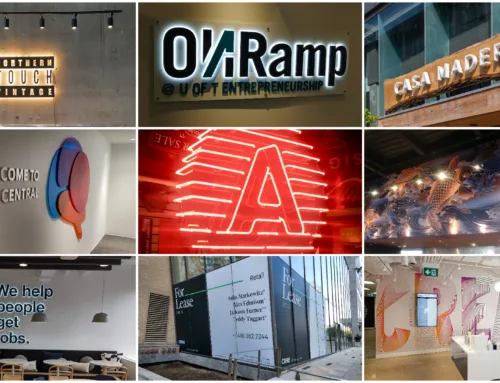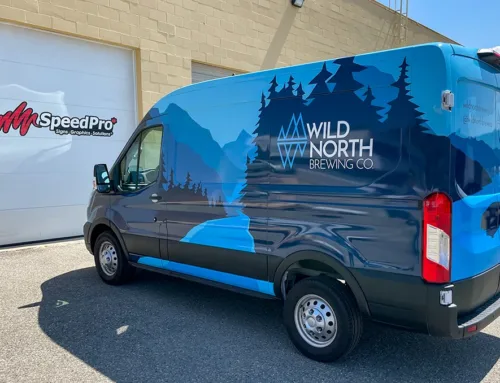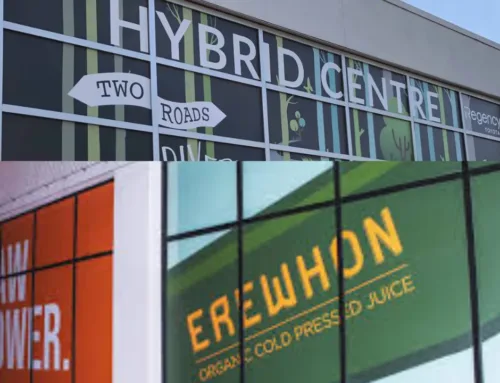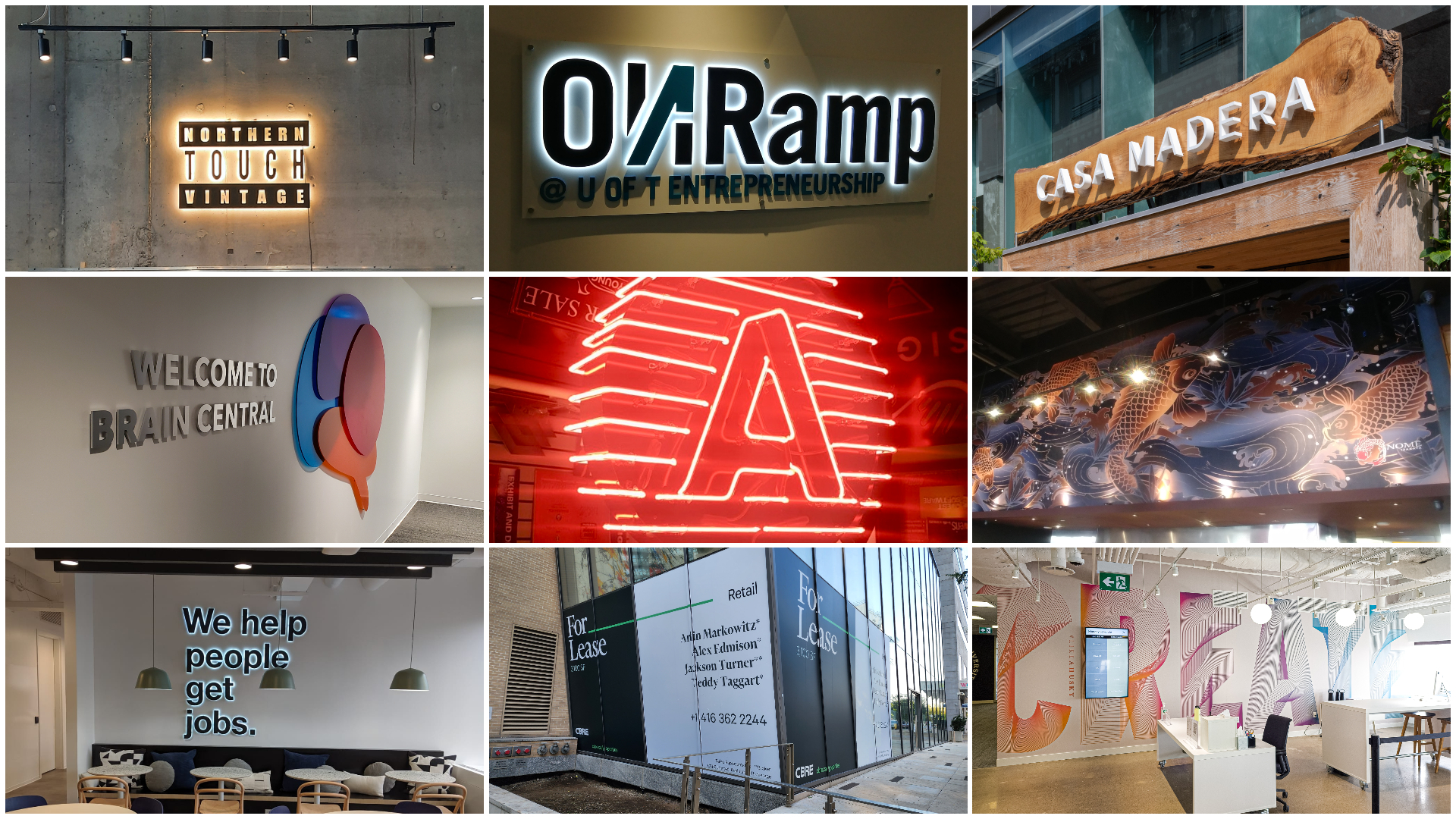
Choosing the right storefront sign in a competitive city like Toronto can be the difference between blending into the streetscape and becoming a local landmark. With so many storefront signage types Toronto businesses can choose from, it helps to understand how each option works, what it costs, and which styles match your brand, location, and by-law rules. This guide focuses on three of the most effective options for urban and suburban businesses: channel letters, blade signs, and lightbox signs.
If you are comparing different sign solutions or planning a complete rebrand, this article is designed to complement our broader resource: Complete overview: “Ultimate Guide: Sign Company Toronto for Custom Business Signs and Commercial Signage Solutions.” Together, these resources give you a strategic view of how to build a powerful, compliant, and consistent presence across your storefront and interior spaces.
Why Storefront Signage Matters in Toronto’s Streetscape
Toronto’s commercial landscape is dense and visually busy. From Queen Street to Yonge, from downtown towers to neighbourhood plazas, your sign has only seconds to attract attention and communicate what you do. Effective retail storefront signs do more than display a name; they:
- Improve visibility from multiple viewing angles and distances
- Communicate brand personality (modern, luxury, family-friendly, professional, etc.)
- Support wayfinding and accessibility
- Increase walk-in traffic and impulse visits
- Reinforce credibility and professionalism
For Toronto businesses, there is an added layer of complexity: zoning, permit requirements, heritage districts, and multi-tenant buildings can all influence which storefront signage types are allowed and where they can be mounted. Working with a local sign company like Signimpact, which serves Toronto and the broader GTA from our Milton facility, ensures your design is both visually effective and compliant with local regulations.
Overview: Main Storefront Signage Types Toronto Businesses Use Most
While there are many possible sign types, three dominate the Toronto storefront landscape due to their visibility and versatility:
- Channel letters: Individually fabricated 3D letters, often illuminated.
- Blade signs: Projecting signs that stand perpendicular to the storefront.
- Lightbox signs: Illuminated cabinets with graphics on one or both faces.
Each of these options can be customized for different building styles and brand aesthetics. Many Toronto retailers and service businesses combine two or more types (for example, channel letters on the fascia combined with a blade sign at pedestrian eye-level) for stronger impact. The sections below break down how each type works and how to decide which is best for your location.
Channel Letters Toronto: High-Impact 3D Lettering for Maximum Visibility
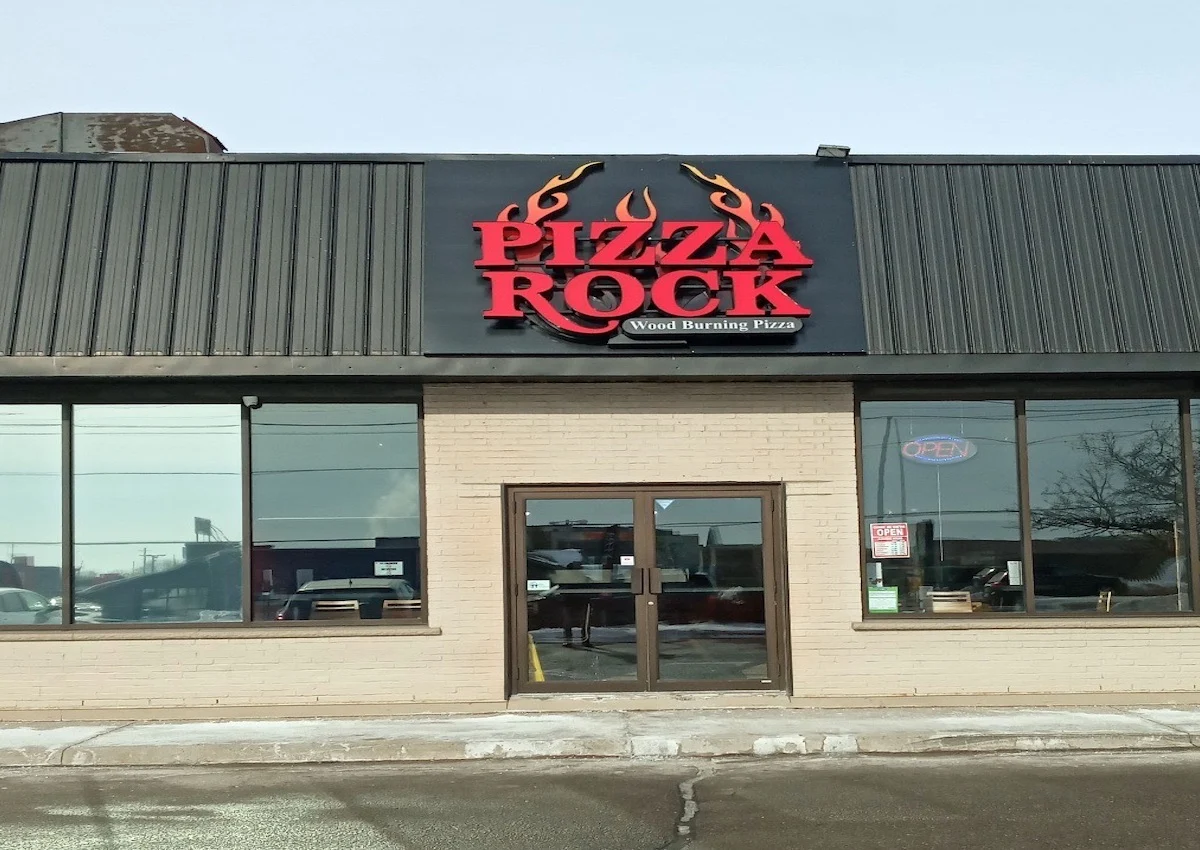
Channel letters are among the most popular retail storefront signs across Toronto’s main streets and plazas. These are three-dimensional letters (and sometimes logo shapes) made from metal and acrylic, often internally lit with energy-efficient LEDs.
How Channel Letters Are Built
Typical components of channel letters Toronto property managers and business owners see include:
- Aluminum returns: The sidewalls that give the letter its depth.
- Letter backs: Usually aluminum, forming the rear of the letter.
- Acrylic faces: Coloured or translucent, allowing light to shine through (for front-lit styles).
- LED modules: Installed inside the letter body for illumination.
- Raceway or direct mount: The method used to secure letters to the building facade.
Common Styles of Channel Letters
When planning channel letters in Toronto, these are the main style options:
- Front-lit channel letters: The most common type. Light shines through the acrylic face, making the letters highly legible at night.
- Backlit (halo-lit) channel letters: Light is projected onto the wall behind, creating a halo effect. Excellent for upscale brands and heritage buildings.
- Front-and-back-lit: Combines both effects for stronger impact.
- Open-face or exposed neon-style: Used for vintage, bar, and entertainment concepts where you want a retro feel.
Best Uses for Channel Letters in Toronto
Channel letters work exceptionally well in these scenarios:
- Plazas and strip malls: They align with other tenants while still allowing customization of colour and style.
- Mixed-use buildings and towers: High-mounted channel letters ensure visibility from a distance.
- National and local chains: Easy to standardize across multiple locations while complying with each landlord’s criteria.
Many Toronto landlords actually require channel letters in their signage criteria. Signimpact frequently works with property managers to ensure your new sign meets landlord specs on size, mounting, and electrical access.
Pros and Cons of Channel Letters
| Pros | Cons
|
|---|---|
| Highly visible day and night | Higher upfront cost than basic flat signs |
| Strong, professional brand appearance | Requires electrical access and permits |
| Durable construction suited to Toronto weather | Lead time can be longer due to fabrication |
| Fully customizable shapes, fonts, and colours | Some heritage districts may restrict styles |
If you are opening or rebranding a location in a busy corridor like Bloor, Danforth, or the Entertainment District, channel letters are often the most strategic primary storefront sign type.
Blade Signs Toronto: Pedestrian Friendly Signs That Stand Out
Blade signs are mounted perpendicular to the building facade, projecting over the sidewalk so they can be seen from up and down the street, not just straight on. For dense, walkable areas in Toronto, blade signs play a crucial role in visibility.
Typical Construction of Blade Signs
Blade signs Toronto retailers use are typically built from:
- Aluminum or steel frames: For rigidity and durability.
- Panels: Can be aluminum, acrylic, wood, or composite.
- Mounting brackets: Secure the sign to the wall; often decorative for added character.
- Optional lighting: External gooseneck lights or internal illumination.
Where Blade Signs Work Best
Blade signs excel in these environments:
- Walkable neighbourhoods like The Junction, Leslieville, and Roncesvalles, where most people are on foot.
- Side streets and laneways where your fascia sign might be partially hidden or viewed at sharp angles.
- Heritage or boutique districts where projecting, decorative signs fit the streetscape character.
Even in plazas and suburban retail strips, a smaller blade sign near an entrance can guide pedestrians coming from side parking lots or courtyards.
Illuminated vs. Non-Illuminated Blade Signs
Blade signs can be either illuminated or non-illuminated:
- Non-illuminated blade signs: Cost-effective and suitable for daytime businesses such as salons, cafes, or boutiques that close by early evening.
- Illuminated blade signs: Include internal LEDs or external lighting. Ideal for restaurants, bars, or any business that relies on evening traffic, especially during Toronto’s long winter nights.
Signimpact can integrate your blade sign into a broader storefront package, ensuring it complements your main channel letter or lightbox sign in terms of fonts, colours, and lighting.
Key Advantages of Blade Signs
- Enhance visibility along narrow streets where fascia signs are harder to see.
- Offer strong branding opportunities with unique shapes and materials.
- Provide wayfinding cues at building corners, alley entrances, or second floor suites.
Because blade signs project into public space, Toronto sign by-laws and building owners often have specific rules about size, height, and clearance. A sign partner familiar with local regulations can help you design a compliant, effective solution.
Lightbox Signs Toronto: Versatile Illuminated Cabinets

Lightbox signs (also called cabinet signs) are rectangular or custom shaped boxes with internal lighting and graphic faces. Among the various storefront signage types Toronto businesses use, lightboxes are one of the most versatile for both single-tenant and multi-tenant buildings.
How Lightbox Signs Are Constructed
Lightbox signs Toronto businesses install usually consist of:
- Aluminum cabinet: A durable, weather-resistant box that houses electrical components.
- Translucent faces: Acrylic or polycarbonate panels printed with your logo and text.
- LED or fluorescent lighting: LEDs are now the standard for efficiency and longevity.
- Mounting system: The cabinet can be wall-mounted, pole-mounted, or part of a pylon sign.
Common Uses for Lightbox Signs in Toronto
Lightbox signs are particularly effective for:
- Plaza fascia signs: Especially where landlord criteria call for uniform sign shapes and sizes.
- Canopy or awning fronts: Integrated into building features to save space.
- Shopping centre directories: Multi-tenant lightbox cabinets listing several businesses.
- 24/7 businesses: Pharmacies, clinics, convenience stores, and QSRs needing consistent night visibility.
Single-Sided vs. Double-Sided Lightbox Signs
Lightbox signs Toronto businesses deploy often fall into two categories:
- Single-sided lightboxes: Mount flat against a wall or fascia.
- Double-sided lightboxes: Used for projecting blade-style boxes or freestanding pylon/location signs.
At Signimpact, we frequently combine lightbox signs Toronto retailers order with window graphics and interior wayfinding for a consistent day/night branding package.
Advantages of Lightbox Signs
- Reliable night visibility with evenly distributed lighting.
- Graphics can be updated or replaced without changing the entire structure.
- Often more budget-friendly than complex 3D lettering for larger sign areas.
Comparing Storefront Signage Types: Channel Letters vs. Blade Signs vs. Lightboxes
To help you narrow down which storefront signage types Toronto businesses should consider for a given location, here is a side-by-side comparison.
| Feature | Channel Letters | Blade Signs | Lightbox Signs
|
|---|---|---|---|
| Primary Viewing Angle | Straight-on from the street or parking lot | Along the sidewalk / from both directions | Straight-on; double-sided options add side visibility |
| Typical Illumination | Internal LED (front-lit, backlit, or both) | Optional internal or external lighting | Internal LED across entire face |
| Best For | High-visibility branding on plazas, towers, main streets | Pedestrian-heavy areas, narrow streets, boutique districts | Plazas, multi-tenant sites, 24/7 businesses |
| Customization Level | Very high – 3D shapes, fonts, halo effects | High – shapes, materials, and mounting styles | Moderate – custom graphics within a defined box |
| Relative Cost Range* | $$–$$$ | $$ (non-illuminated) to $$$ (illuminated) | $$ |
| Common Pairings | With blade signs and window graphics | With channel letters or lightboxes | With window graphics and pylon signs |
*Cost ranges are relative and depend on size, materials, illumination, engineering, and installation conditions.
In practice, many Toronto storefronts benefit from using two of these signage types together: channel letters or lightbox signs for long-distance visibility, plus a blade sign for close-range pedestrian traffic.
How to Choose the Right Storefront Sign for Your Toronto Business
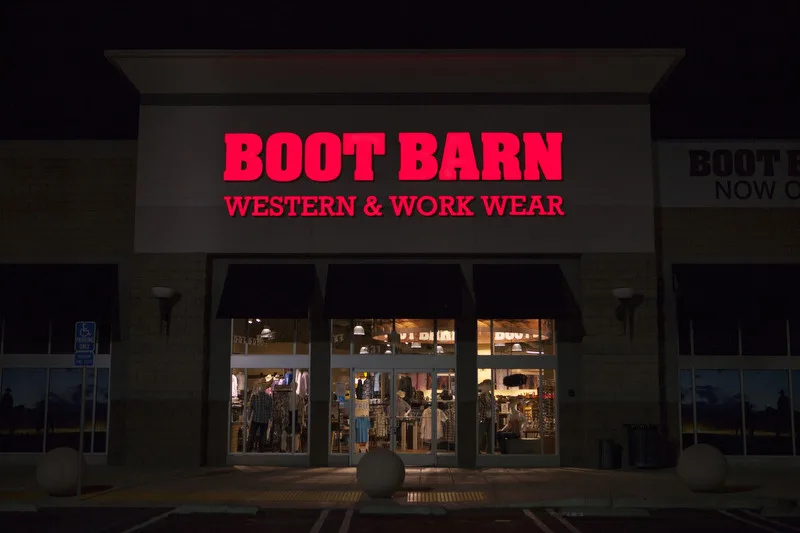
Selecting among the various storefront signage types Toronto offers is easier when you follow a structured process. Here is a step-by-step approach that Signimpact uses when advising clients.
1. Clarify Your Main Visibility Goals
Ask yourself:
- Do most customers approach by car, transit, or on foot?
- Can they see your storefront from a distance, or only when they are close?
- Are you on a main street, a side street, or inside a plaza?
If vehicle traffic is key, large channel letters or lightbox signs mounted high on the fascia may be critical. If foot traffic dominates, a well-designed blade sign and window graphics might be just as important.
2. Review Landlord Criteria and City By Laws
Before you fall in love with a design, verify:
- What your building’s signage criteria permit (size, materials, lighting).
- Toronto’s sign by law requirements, including maximum area and projection limits.
- Whether your area is in a heritage district or special zone with additional restrictions.
Signimpact routinely helps Toronto businesses review criteria and prepare drawings for permit applications, reducing delays and rework.
3. Align the Sign Style With Your Brand
Your storefront sign should match your brand’s tone:
- Modern tech or medical clinic: Clean, front lit channel letters and minimalistic blade signs.
- Boutique retail or café; Decorative blade signs, halo lit channel letters, or a warm, framed lightbox.
- Value-focused or 24/7 retail: High contrast lightbox signs and bold window graphics.
Signimpact’s design team can translate your brand guidelines into practical sign layouts, colours, and lighting plans suited to Toronto’s environment.
4. Consider Budget and Long Term Maintenance
Channel letters may cost more upfront than a basic printed sign, but they often deliver greater long-term value through increased visibility and durability. Similarly, LED-illuminated blade signs and lightbox signs have higher initial costs than non-lit options but significantly improve nighttime performance.
Ask about:
- Expected lifespan of materials and LEDs.
- Ease of access for maintenance on multi storey buildings.
- Warranty coverage and service options.
5. Think in Terms of a Storefront System, Not a Single Sign
The most effective retail storefront signs in Toronto work as a cohesive system:
- Main illuminated sign (channel letters or lightbox).
- Secondary blade sign for side or pedestrian angles.
- Window graphics and films to communicate key messages and hours.
- Interior wall graphics and wayfinding to extend the experience inside.
Because Signimpact handles both outdoor and indoor signage, we can help you design a full package that supports brand recognition from the street through to the point of sale.
Realistic Use Cases for Toronto Retail Storefront Signs
Below are examples of how different kinds of businesses might combine the storefront signage types Toronto has to offer.
Example 1: Downtown Coffee Shop
- Main sign: Halo-lit channel letters directly on the brick facade.
- Secondary sign: Double-sided blade sign above the entrance for pedestrian traffic.
- Extras: Window decals showing hours, Wi-Fi, and seasonal promotions.
This mix creates a warm, high-end atmosphere while ensuring visibility along a busy sidewalk.
Example 2: Plaza-Based Dental Clinic in North Toronto
- Main sign: Front-lit channel letters on a raceway to match neighbouring tenants.
- Extras: Frosted privacy films on windows, interior directional signs.
Professional, clean channel letters build trust and are easy to read from the parking lot and street.
Example 3: Convenience Store Open Late
- Main sign: Large lightbox sign with bold, high-contrast graphics.
- Secondary sign: Smaller lightbox or illuminated blade sign near side entrance.
- Extras: Promotional window graphics highlighting key product categories.
This configuration maximizes visibility both for drivers and pedestrians, especially during evenings and winter months.
Working With Signimpact on Your Toronto Storefront Signage
Signimpact is a full-service sign company based in Milton and serving Toronto and the entire GTA. For channel letters, blade signs, lightbox signs, and complementary indoor graphics, we provide:
- Consultation and site assessment: Reviewing viewing distances, traffic patterns, and by law constraints.
- Custom design: Translating your brand into effective, code compliant sign concepts.
- Permit assistance: Preparing drawings and helping you navigate Toronto’s sign permitting process.
- Fabrication: Using quality materials and LED lighting suitable for Canadian weather.
- Professional installation: Coordinating with landlords, property managers, and electricians as needed.
Because we also offer window graphics, wall decals, and vehicle wraps, we can help you build a consistent visual identity across every customer touchpoint.
Frequently Asked Questions About Storefront Signage Types in Toronto

1. Do I need a permit for channel letters or lightbox signs in Toronto?
Most permanent illuminated storefront signs, including channel letters and lightbox signs, do require permits in Toronto. Requirements can vary by ward, zoning, and building type. Signimpact assists clients by preparing drawings, specifications, and documentation to support your permit application and by coordinating with local authorities where necessary.
2. Which is more visible: channel letters or a lightbox sign?
Both can be highly visible when designed correctly. Channel letters create a premium, three dimensional look that stands out against the building facade. Lightbox signs provide continuous illumination across the entire face, which can be easier to read from longer distances, especially for complex logos or long business names. The best choice depends on your building, landlord criteria, and brand style.
3. Are blade signs allowed everywhere in Toronto?
Blade signs are common across many Toronto neighbourhoods, but their size, height, and projection over public spaces are regulated. Some buildings and heritage areas have specific rules on materials and design. When planning blade signs in Toronto, it is important to consult both municipal by laws and your landlord’s signage criteria. Signimpact can guide you through these requirements during design.
4. How long do LED illuminated storefront signs last?
Quality LED modules in channel letters, lightbox signs, and illuminated blade signs typically have a lifespan of tens of thousands of hours of operation. In practical terms, that can translate into many years of service with minimal maintenance, depending on how long your lights are on each day. Regular inspections and occasional cleaning help ensure maximum brightness and longevity.
5. Can I update graphics on my lightbox sign without replacing the whole sign?
Yes. One of the advantages of cabinet style lightbox signs is that the internal structure and lighting can remain in place while the graphic faces are replaced. This makes rebranding or updating tenant names more cost-effective than changing an entire sign system.
Conclusion: Choosing the Best Storefront Signage Types Toronto Businesses Can Rely On
Among the many storefront signage types Toronto businesses can choose from, channel letters, blade signs, and lightbox signs stand out for their versatility, visibility, and compatibility with local streetscapes. The right mix depends on your location, brand, landlord criteria, and budget but when strategically combined, these sign types can dramatically increase your presence and foot traffic.
Signimpact helps Toronto and GTA businesses navigate every step: from selecting the right sign type and securing permits to custom fabrication and professional installation. If you are planning a new location, renovation, or rebrand, consider your storefront as a complete system rather than a single sign. For a broader look at additional sign options, indoor branding, and project planning, explore this resource as well: Complete overview: “Ultimate Guide: Sign Company Toronto for Custom Business Signs and Commercial Signage Solutions.”
Ready to discuss channel letters, blade signs, or lightbox signs for your storefront? Contact Signimpact to schedule a consultation and receive recommendations tailored to your Toronto business and property.